
Anyone who has watched an elephant walk silently down a dry riverbed in Damaraland knows the feeling: this animal seems to belong to another scale of existence. At up to six tonnes, the African savanna elephant is the largest land animal on Earth, and nearly every part of its body is a small marvel of engineering. Here’s a closer look at how an elephant is put together, and why those features matter so much for the desert-adapted elephants we work alongside in Namibia.
The Trunk: Nose, Hand, Hose and Snorkel
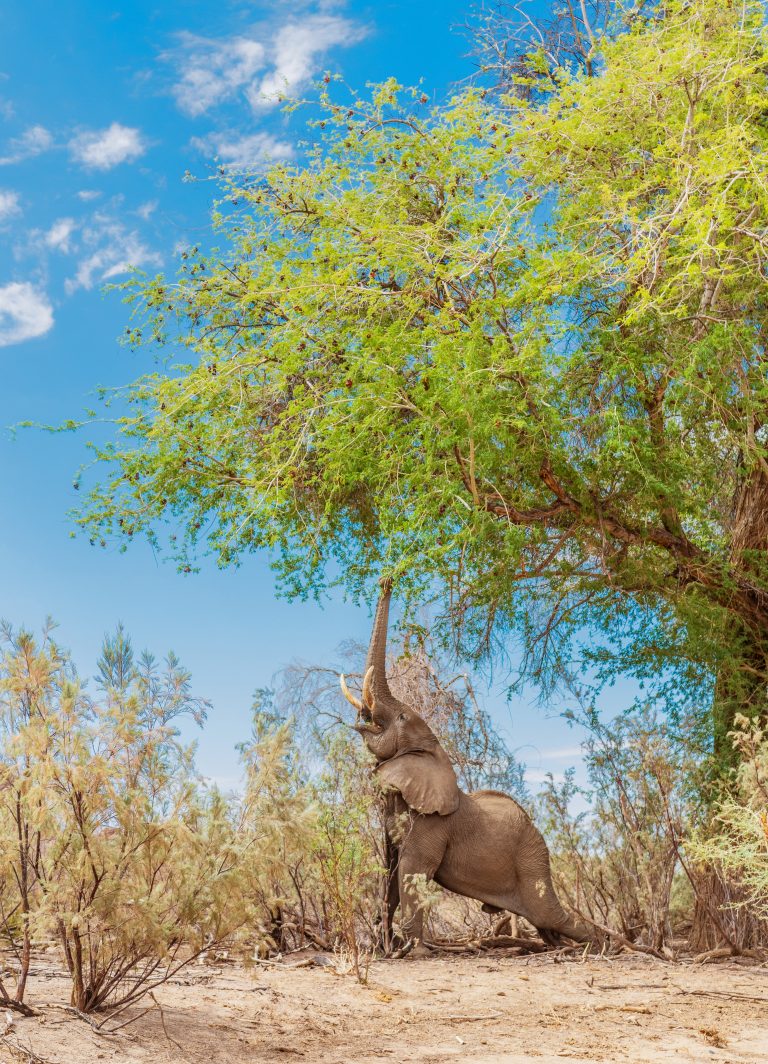
An elephant’s trunk is a fusion of its nose and upper lip, and it contains no bones at all. Instead, it is made of tens of thousands of muscle bundles, giving it extraordinary strength and precision. The same trunk that can rip a branch from a tree can pick up a single seed pod.
African elephants have two finger-like projections at the tip of the trunk, which they use to pinch and grip. The trunk is also a remarkable sense organ. Elephants have one of the most powerful senses of smell of any animal, and in the desert this matters enormously: it helps them locate water, food and each other across vast distances.
The trunk doubles as a drinking straw. An adult can draw up several litres of water at a time and squirt it into its mouth, or spray it over its back to cool down.
Ears: The Elephant’s Air Conditioner
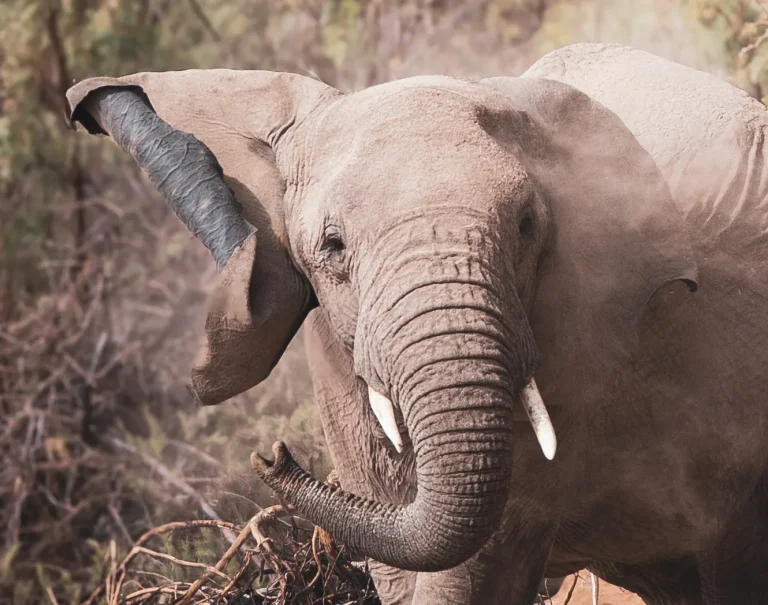
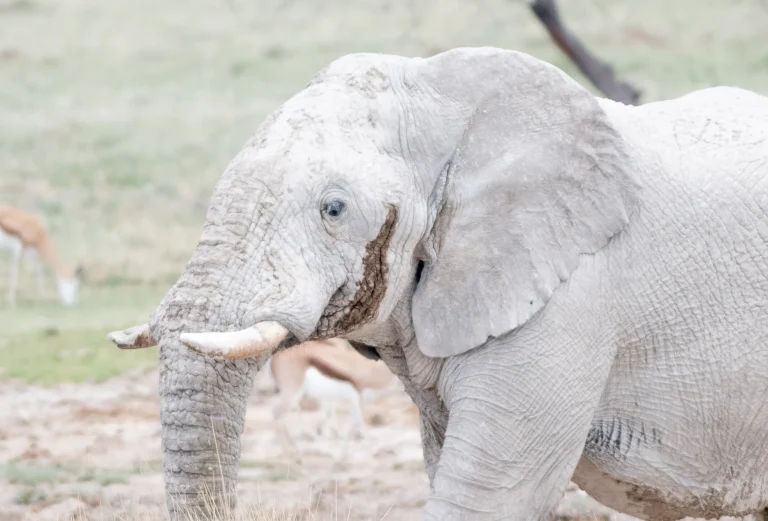
Those enormous ears aren’t just for hearing. They are threaded with a dense network of blood vessels, and when an elephant flaps its ears, air flowing over them cools the blood before it circulates back through the body. Since elephants can’t sweat the way we do, this is one of their most important tools for surviving the heat of the Namib and its surrounding regions.
Ears also communicate. An elephant spreading its ears wide is making itself look bigger, often a sign of alarm or a warning to back off, which is one of the first signals we teach volunteers and community members to recognise.
Tusks and Teeth
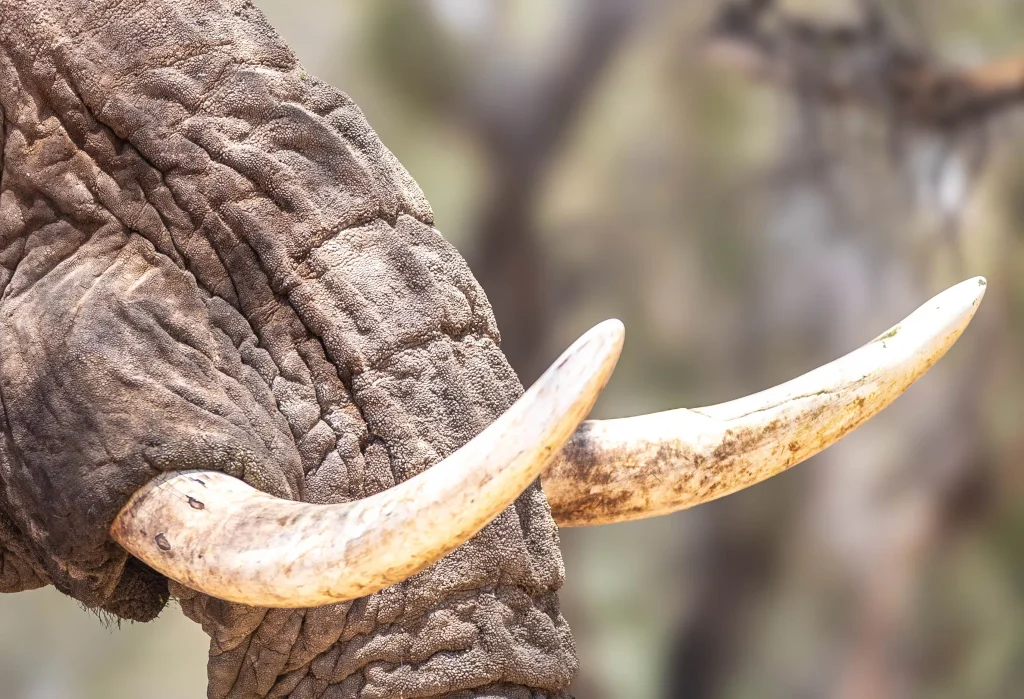
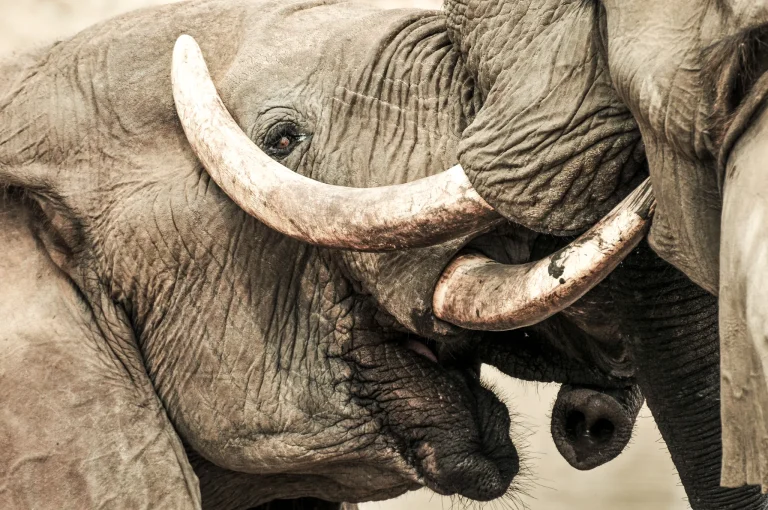
Tusks are elongated incisor teeth made mostly of dentine, and they keep growing throughout an elephant’s life. Roughly a third of each tusk is hidden inside the skull. Just as people are right- or left-handed, elephants tend to favour one tusk, which often shows more wear.
In the desert, tusks earn their keep. Elephants use them, together with their feet and trunks, to dig into dry riverbeds to reach water below the surface, and to strip bark from trees.
Their chewing teeth are just as fascinating. Elephants go through six sets of molars in a lifetime. Rather than growing in from below like ours, new molars move forward along the jaw like a slow conveyor belt, replacing worn ones. When the final set wears down in old age, an elephant can struggle to feed, which is one of the natural limits on its lifespan.
Feet That Listen
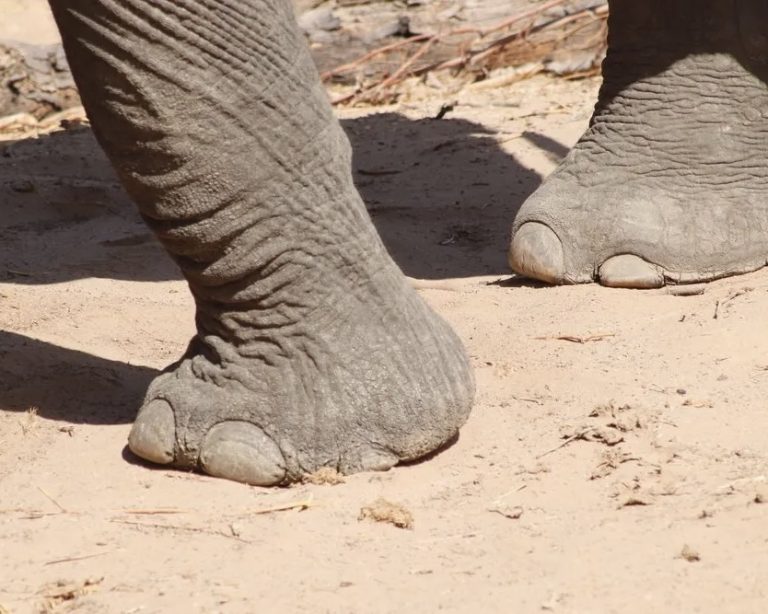
An elephant is technically walking on tiptoe. Behind its toe bones sits a thick cushion of fatty, fibrous tissue that absorbs its enormous weight, which is why elephants move so quietly for their size. Researchers have also identified a small extra bone, sometimes called a “sixth toe,” that helps support the foot.
Those feet are sensitive, too. Elephants communicate using deep, low-frequency rumbles, many below the range of human hearing, which can travel for kilometres. Some of these vibrations travel through the ground, and elephants appear to pick them up through their feet and trunk. In a landscape as open and sparse as the northwest of Namibia, long-distance communication like this helps family groups stay in touch.
Inside the Giant
An elephant’s brain weighs around five kilograms, the largest of any land animal, with well-developed areas linked to memory. That famous elephant memory is real, and for desert elephants it may be a matter of life and death: matriarchs remember the locations of water sources and routes across huge home ranges, sometimes returning to places they haven’t visited in years.
Elephants also have an unusual respiratory system. Unlike almost every other mammal, their lungs are attached directly to the chest wall rather than floating in a fluid-filled space. Scientists think this may be connected to their ability to breathe through a raised trunk while swimming.
Their digestion is fairly inefficient, with much of what they eat passing through only partly digested. That’s why an adult spends most of its day feeding, and why elephant dung is so valuable to the ecosystem, spreading seeds and nutrients across the landscape.
Elephant Reproductive Anatomy
Elephant reproduction is as unusual as the rest of their biology, and it’s one of the most common things people wonder about.
Males:
Unlike most mammals, male elephants have no external scrotum. Their testes sit internally, near the kidneys, which may help protect them and keep them at the right temperature. The penis is retracted inside a sheath when not in use. It is large and highly muscular, reaching around a metre in length in a mature bull, and it has a distinctive S-shape when erect. Because it is so muscular, a bull can move it with a surprising degree of control, which helps compensate for the practical challenges of mating when you weigh several tonnes.
Females:
A female elephant’s genital opening sits lower and further forward than in most mammals, between the hind legs rather than beneath the tail. It leads into a long urogenital canal. Females also have a relatively large clitoris. Another surprise is the position of the mammary glands: cows have two teats between their front legs, much like primates, so calves suckle using their mouths while standing tucked in close to their mother’s chest.
Reproduction and the long wait:
A female is receptive for only a few days in a cycle of around three to four months, and she advertises this through low-frequency rumbles and chemical signals that bulls can detect from far away. If she conceives, pregnancy lasts around 22 months, the longest of any land mammal. The calf is born weighing roughly 100 kilograms and can usually stand within an hour or so. Because of this long pregnancy and years of nursing, a cow typically gives birth only once every four to five years, which is one reason elephant populations recover slowly from losses.
Musth:
Adult bulls periodically enter a state called musth, when testosterone levels rise sharply. Signs include a dark, tarry secretion running from the temporal glands between the eye and ear, and a steady dribble of urine that can stain the insides of the hind legs. Bulls in musth are more assertive and can travel widely in search of receptive females. For our team and for communities living alongside desert elephants, recognising a bull in musth is an important safety skill, as these bulls deserve extra space and caution.
Not a Separate Species, but a Remarkable Adaptation
It’s a common question: are desert elephants a different species? They aren’t. Namibia’s desert-adapted elephants are African savanna elephants whose behaviour, knowledge and social traditions have allowed them to thrive in one of the harshest environments on Earth. Their anatomy is the same toolkit every savanna elephant carries, used with extraordinary skill.
Understanding how elephants are built helps us understand what they need: water, space, and safe passage. When elephants come into conflict with people over water points, it’s that same trunk, strength and memory that lead them to farms and villages. By building protective walls around water sources and working with local communities, EHRA aims to help people and elephants share this land safely.
Want to see these incredible animals up close?